Saturday, May 14, 2011

Ex HMAS Adelaide wreck dive, Terrigal, NSW 11 May 2011

The ship was only scuttled 4 weeks ago and we were amongst the first members of the public to be allowed to dive her on Wednesday 11th May, 2011.


We  left Terrigal at 8am which meant I left home at 5am. With hindsight this was probably 30 mins too early given that I was on the Central Coast by 6:40am. It was a perfect morning although it was a little chilly but once the wetsuit was on that was quickly forgotten.


Here is my video of the first dive to some nice music.


HMAS ADELAIDE (FFG-01) was a long-range escort frigate with roles including area air defense, anti-submarine warfare, surveillance, reconnaissance, and interdiction. The Ship could simultaneously counter threats from the air, surface and sub-surface.
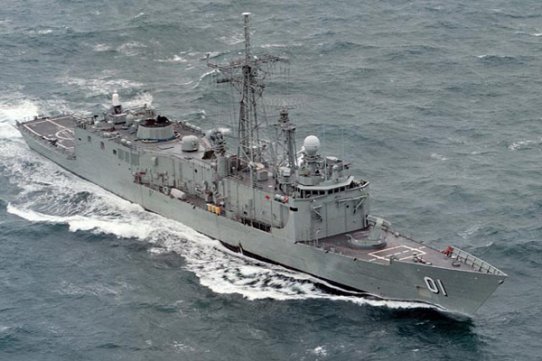
HMAS Adelaide in service


She was scuttled on April 13th 2011 after many years of controversy and court battles by parties with their own interests and agenda claiming to be environmentalists (not so enviro and more mental really!)

TECHNICAL DATA
Displacement 4100 tonnes
Length 138 metres
Beam 13.7 metres
Ships Company 186 (210 with helicopter crews)
Propulsion Two General Electric LM2500 gas turbines driving a single controllable pitch propeller
Speed 30+ knots
Weapon Systems 76mm rapid fire gun. Harpoon anti-ship missiles. Standard surface to air missiles.
Vulcan Phalanx close in weapons system. Two triple anti-submarine torpedo tubes for Mk 32 torpedoes.
Aircraft Up to two SeaHawk helicopters

Our skipper from Pro-Dive was Bob and he ensured all the necessary paperwork and checks were done before we headed out.
Bob pictured before the Adelaide was scuttled.
The visibility was about 5M and the wreck itself is huge. It sits in 30M of water with 2M under the sand, so you can get down to 32M inside the ship but only 30M outside. I imagine the sand line will creep up outside the ship over time.
We started about mid ship and made our way to the starboard bow. At the bow we could see her proud :01: numbers and found a small swim through  (apparently through the laundry) and went through to the port side. We then headed up to the upper deck and swam back past the mast and funnel. We could see divers deep inside the wreck from the top of the funnel.
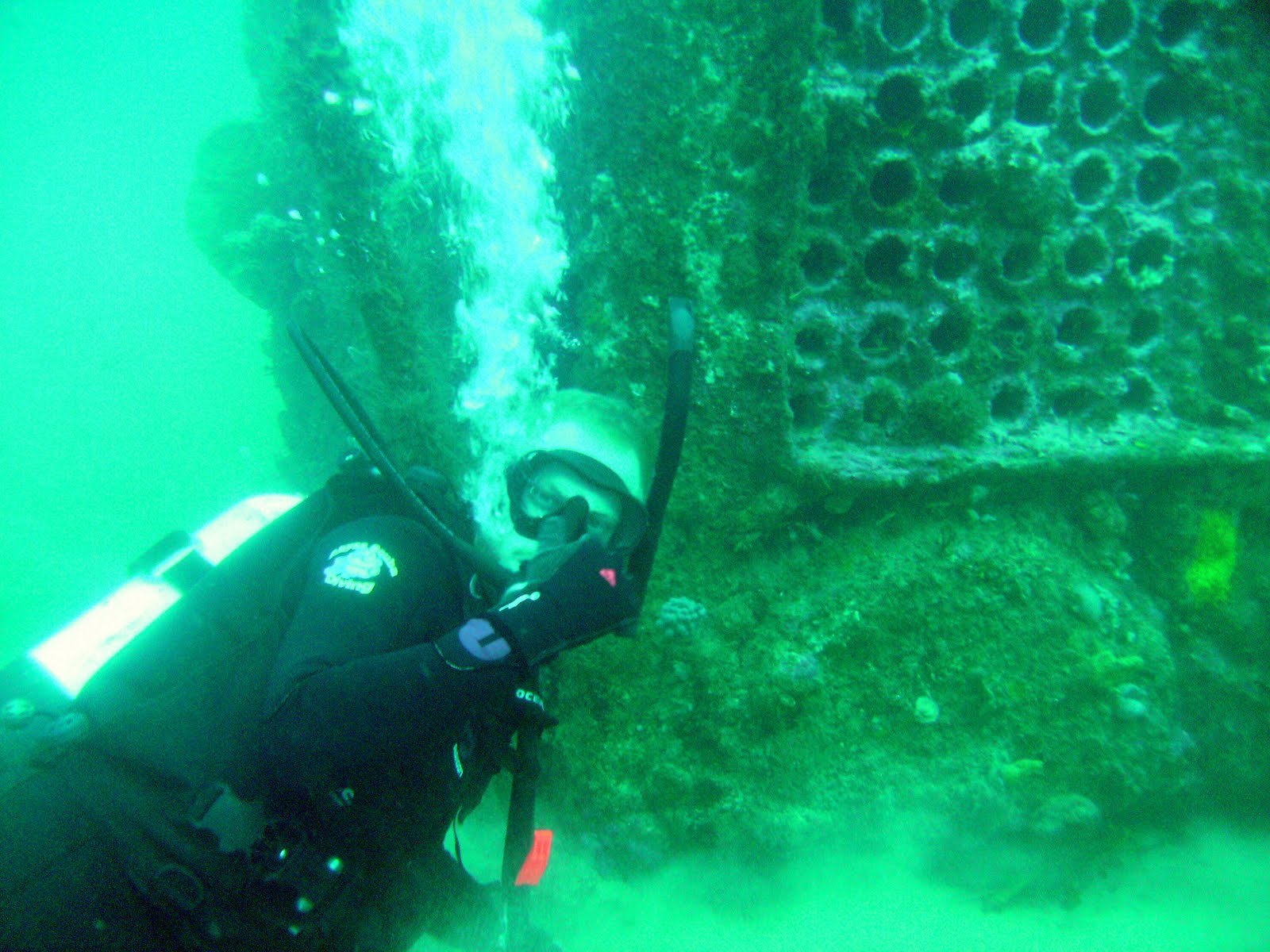
Me in the Captains chair
From the Funnel we went to the top of the helicopter deck but did not descend in order to avoid a sawtooth dive pattern. We turned back and found an anemone that has started to grow inside the bucket on top of the helicopter hangar.

We turned back and did a blue water stop for 1 min @ 9M and a safety stop for 3 min @ 5M. We headed back to shore, only a 5 min trip, to get our second tanks and take our 1 hour surface interval before the second dive.
At 10 am we headed back out for our second dive and I took photographs this time. I was using my new Intova 12M pixel camera, new slave flash and new wide angle lens attachment. 
Lindsey was my buddy and we planned to enter the ship this time and have a look around.

We swam into the middle of the ship on a mid deck and it was very dark. Lindsey decided not to follow me so I turned back and we swam up to the bridge.The Bridge is still recognizable and the captains chair is still there and will undoubtedly be the source of many photographs.
information on the bridge


The bridge console
After the bridge we swam back along the top deck and found this little array of plugs and things that will probably become a haven for marine life in the future.

We ascended up the mast this time and the top of the mast is in about 10m. We stopped @ 9M for 1 min and again a safety stop @ 5M for 3min.

On the day it was very business as usual but now I look back these were probably the two best dives i have ever done. The ship is a magnificent dive attraction and will take many dives to become familiar with the layout and will only be enhanced as the marine life moves in.

The inaugural Abyss dive on the HMAS Adelaide crew

After the dive i had fish and chips with Keith, Jenny , Brett and Michelle. I went to the top of the nearby lookout and took a picture of the wreck location. It is difficult to see the buoys in this picture but this is where she lays off Avoca Beach.
The location of the HMAS Adelaide from the surface
211-212

Monday, May 9, 2011

PADI Advanced Diver Course 7/5/11

I did a write up of this weekend but it all got lost in the blogger crash on May 12th-  Maybe I'll write it up again... or maybe not. Here are some pictures from the weekend.
Hugues Brastel


Duncan Fish


James Mathews


Daniel Anderson


James Dean


205-209

Friday, May 6, 2011

Open Water Course Lilli Pilli and Camp Cove

Another open water course this weekend with 2 students who unfortunately did not complete all the requirements during the weekend so will need to come back for their final dive before certification.
Theresa, me and Anthony


Saturday was a wet and miserable day and all our clothing got soaked while we were in the pool.

Sunday was a great day at Camp Cove and we completed Open Water Dives 1,2, and 3.


202-205

Tuesday, April 19, 2011

Open Water Course, Lilli Pilli and Camp Cove

Another Open Water course this weekend in what started off as a very wet Saturday morning but ended up as a pleasant sunny Sunday afternoon.


Ulrika, Olaf, Emma, Bret, Andrew, Adam and me


Our Saturday afternoon dive let me touch a Wobbegong on the tail, he was inside the Shark Net at Lilli Pilli. I have no idea how he got in there, unless someone caught him on the pier and dropped him in.

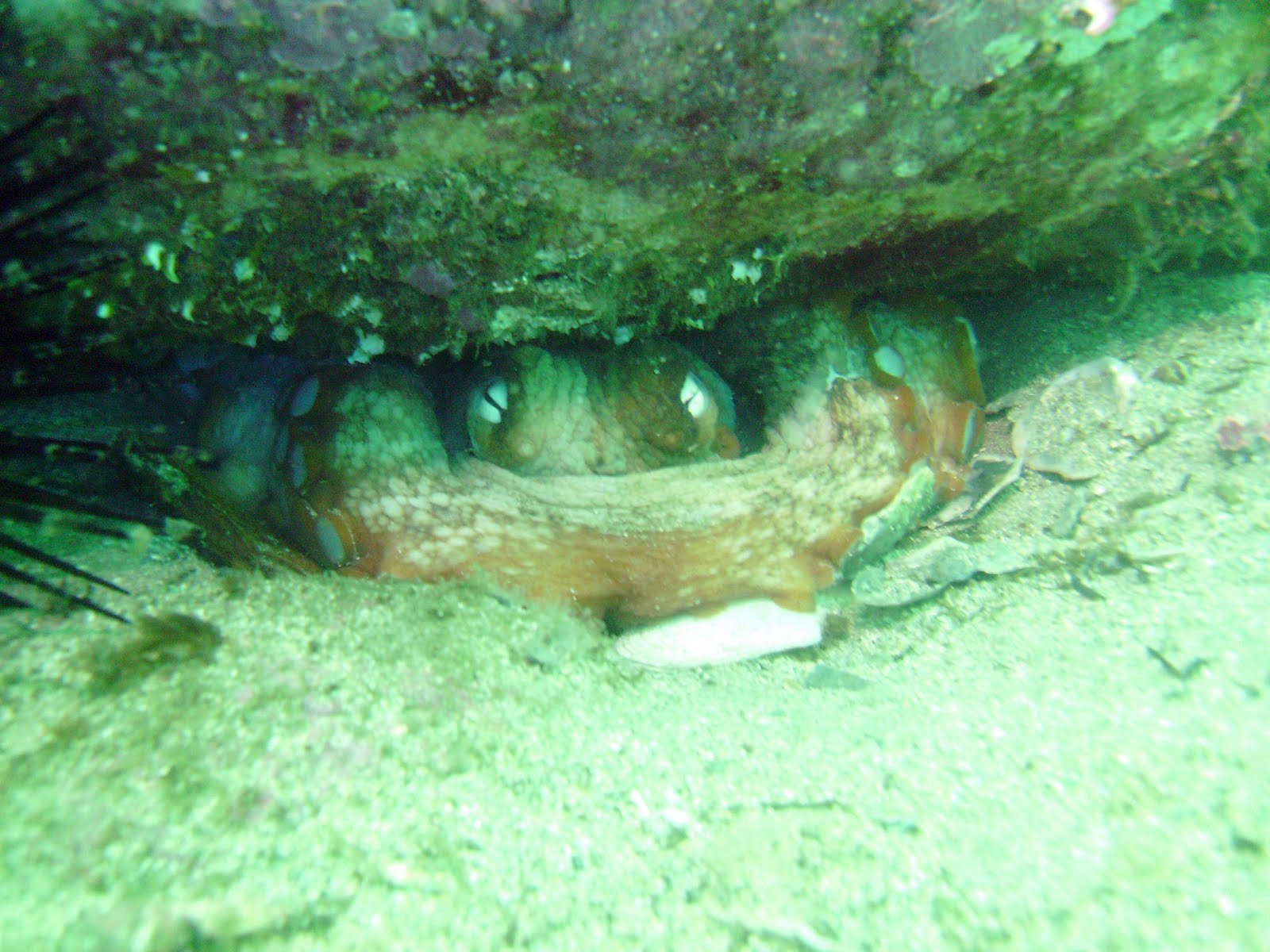
Day 2 was at Camp Cove and we had a lot of fun with the Octopus and Juan and Kali joined us for the course.
Juan, 2 scuba refreshers, Kali

3 dives at Camp Cove in my new wetsuit Vulcan 7/6 semidry -awesome wetsuit I highly recommend it.


197-201

Monday, April 11, 2011

Advanced Open Water Course, Oak Park, Royal Shepherd and The Centurion

Four open water  divers became students again this weekend to undertake the Advanced Open Water Course with Abyss Scuba Diving. This time  there would be no mask floods.  This was about learning different types of diving and increasing their in-water skills.

Patrick, Corinna, Petra and Jonathon were going to complete five adventure dives during the course after having completed all of their theory online. The first day took us out to Oak Park where Sydney put on an awesome day .
Petra hovering

Patrick hovering

First adventure dive was Peak Performance Buoyancy. After a dive briefing we headed out with our 3 submersible rings for the course. We completed a surface buoyancy check and removed more weight from the divers than I could safely carry (I think we removed about 18lb in total), so I put some on the sand to take back after the dive.  We descended and completed a fin pivot into a hover, before having a swim around: A number of Blue Gropers came to see what we were up to and stayed with us for the duration of the dive.  They are always so curious as to what we are up to. After a lot of practice hovering again we had some fun swimming through the rings at different depths. I think everyone got a lot from this dive and the skills learned here were practiced throughout the weekend. Patrick particularly liked hovering upside down and practiced it on every dive.

Second adventure dive was Underwater Navigation: After an on-land compass usage refresher, a good discussion about natural navigation and a practice of our navigation patterns for the dive, we went for our second dive. The visibility was excellent at Oak Park and it probably made this course a bit easier because we could see 20m. Everyone learned how many kick cycles they need to travel 30m and approximately how long it takes them to travel that distance. I was really impressed with everyone's square navigation. There was time on this dive for playing with the Blue Groper again, who wouldn't leave us alone, and practicing our hovering techniques.

ball of catfish
Last adventure dive for Day One was the Underwater Naturalist dive: The students had to identify 2 plants, 4 invertebrates and 5 vertebrates. This was easier than it sounds and I only caught one person out with the sponge, which is an invertebrate animal but most people think it is a plant. This was a great dive and we saw so much. We saw the biggest ball of cat fish, they were about 2m long. Corinna has a knack for spotting Moray Eels which she displayed magnificently on this dive. Sam joined us and took plenty of photos.


Cuttlefish on the Underwater Naturalist dive


Sam capturing the kodak moment

One of the many vertebrates that we found

Day Two had 2 adventure dives in Sydney Harbour, Deep and Wreck. We met at Camp Cove at about 9:45am and geared up before waiting to be picked up by our boat for the day. The boat arrived for us at 10:15am so we swam out and headed out to our deep dive for the day on the wreck of the  Royal Shepherd.

We descended the anchor line and tied my reel off at the bottom of the anchor. We headed in the direction that the anchor had been dragging in the sand and found the wreck about 20m from the anchor.

Royal Shepherd in better condition


On Monday 14 July 1890 at 11.15 pm the SS Hesketh, a heavily laden collier heading into Sydney Harbour, collided with the Royal Shepherd and she sank within 10 minutes, luckily no lives were lost.

Petra and Jonathon at the propeller of the Royal Shepherd


We explored the propeller, flywheel and boiler of the old steamer. We made note of some changes in colour at depth and had a bit of fun with an egg.  There was a wobbegong sitting in the flywheel and he blended in very well with his surrounds. We ascended and hung on the anchor line for our safety stop before surfacing.


Corinna near the propeller of the Royal Shepherd

Corinna at the fly-wheel of the Royal Shepherd

Patrick at the boiler of the Royal Shepherd
Corinna at the boiler of the Royal Shepherd


Map of the Centurion - Courtesy of NSW Heritage Office
We had donuts, tea, soup, biscuits and jellies for lunch before heading over to our second dive for the day, the wreck of the Centurion. We descended the line and everyone was now excellent at maintaining good buoyancy and we all hovered around the wreck like blowflies, rather than dragging along the bottom kicking up sand. Everyone identified various hazards around the wreck with our distinctive nose wave signal and we read the plaque and fed the fish while we were down there.


The plaque 18m below the surface on the wreck of the Centurion

Jonathon on the wreck of the Centurion

Moray Eel on the Centurion
Sergeant Baker got very excited when we fed the fish with Snappy Tom

We ascended the anchor line and performed our safety stop before returning to camp cove with 4 newly certified Advanced Divers. Well done!

193-197

Monday, April 4, 2011

OWSI Lilli Pilli and The Steps

Another weekend of Open Water course with 4 students this weekend.
Daniel, David, Chris, Billie, George and me
 I spent most of the weekend with Billie and George. We found a rather large Wobbegong at Lilli Pilli on Saturday afternoon which was particularly exciting given that he was under a ledge near the entry and exit point.

Lilli Pilli has a lot to offer as a dive site if you take your time and look carefully. We found an Octopus, cuttlefish and Old Wives We fed the Bream with some Snappy Tom and a small Snapper came in to see what was going on.  We went along the net to the Pier and back along the reef until the visibility closed in. We saw Leather Jackets and heaps of fish on the other side of the net. Awesome dive at Lilli Pilli!

Day 2 saw us at The Steps, I must admit I was a bit unsure of the logistics of conducting an OW course at the Steps when I first heard about the location, 3 trips up and down the Steps seems daunting but it is actually a great site for this course. It has large sandy patches in about 8M - 10M of water for the skills and has great marine life in the surrounding sponge gardens and seaweed beds for very interesting after skill swims.
On Dive 2 of the course (the first dive of the second day) we completed our surface skills and conducted the CESA for each student then after a line descent conducted a few more skills. We went for a swim after our first fin pivot and met a very friendly Blue groper. He hung around with us for quite some time and just wanted to know about everything we were doing.

On dive 3, after our surface compass skills, we did a visual descent and we had to move along a sting ray who was sitting in the middle of our sand patch before we could conduct our second lot of ocean skills. After all the skills were satisfactorily completed we went for a swim around the beautiful sponge gardens to the east of the Steps.

On the last dive of the day we had a lot of fun with the hover in about 10M. I enjoy this skill and I think the students really get a good feel for buoyancy in the deeper water where they aren't fixated with their inflator/deflator and just use their lungs. We fed the fish again on a swim after this dive, the YellowTails really like the Snappy Tom tuna.

A great weekend with a great bunch of Students.

189-192